
I want to wish you one and all a VERY HAPPY NEW YEAR!!
Have you created resolutions for the new year? Do you generally or is this a year to not do resolutions? Maybe instead you want to create new habits. Is there a distinction? I plan to read my Bible EVERY SINGLE DAY even if I just get one or two verses. Life can get busy, I realize that but what is truly important to you? Be sure it’s first. God, family, work, friends? In the comments, I’d love to know just ONE of your goals, resolutions, habits, or whatever it is you truly plan to DO this year.
My name is Patricia. I’m an Independent Stampin’ Up® demonstrator here in Alaska. I’ve got one more year as a teacher up in the village where I’ve been teaching for last few years. I teach 2nd and 3rd grade this year and LOVE it; however, living in the village is a hard life so I’ll be coming back home permanently after this school year or at least that’s my plan. My home is in Palmer, Alaska and that’s where I plan to be after this year. May or may not sign one more year contract.
So, I blog here periodically. Currently, I do not have a specified date and time because I have so many calls on my time. This year I hope and pray to be more consistent but not going to commit to exactly when or how often. After moving back home, I will likely be better at this.
Hopefully 2024 was a good year for you and 2025 will be better.
Now on to the Color Wheel from Stampin’ Up! Yes, we have a new color wheel that I think is going to be a wonderful tool for us as we try to put our cards or scrapbook pages colors together. Now it is easy to find colors if you’re using DSP (Designer Series Paper) because the colors are already all there but what if you’re using a single color or want a highlight color? Or just want to make your own DSP paper? Or want to use only cardstock?
To begin, let’s look at the basic color wheel that we’re taught (usually) in school.
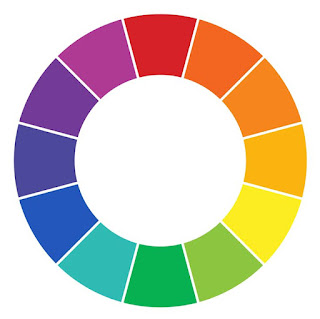
There are 12 colors in a basic color wheel which looks a lot like a beautiful rainbow. Stampin’ Up has taken it a step further by creating our own color wheel with Stampin’ Up colors (except Neutrals) though the Neutrals are all on the back.

Then SU (Stampin’ Up) helps us by giving us examples of color schemes and how to create our own.
The first and easiest is Monocramatic which means “one” color scheme – for example Blues, Reds, or Greens. These basics are then broken down further into the shades between each of these – Blue/Green, Blue/Violet, Red/Orange, Yellow/Orange etc. Each of the Stampin’ Up colors radiates from these families. For example:
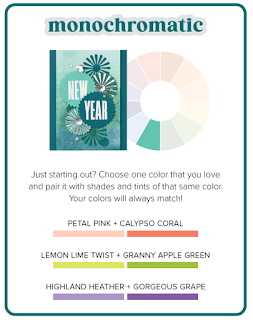
To use Monochromatic colors in a project, you simply select a color that you like, for example, my favorite, blue then look at the colors within that family – Balmy Blue, Azure Afternoon, Misty Moonlight, Boho Blue, Blueberry Bushel & Night of Navy. Pick two or three colors from within that range & craft away!
The next color scheme is Analogous when you choose three colors that are next to each other on the color wheel. For example:

An Analogous color scheme is achieved by combining one color with its closest neighbors on the color wheel. By choosing Analogous colors for your creation, you’re ensuring a look of cohesion and harmony, as these combinations are known for their calming effect in artistic design.
And finally, there is the Triadic color scheme made by finding three colors equally spaced from each other around the color wheel.

These color combinations can feel somewhat predictable (think red, yellow, blue) as they are dynamic or maybe even unexpected. If you think of the color wheel as a dial, you can find a triadic color combination you like by shifting the dial one click at a time away from the primary hues. Then it’s a good idea to select a dominant color letting the other two colors play a supporting role on your card or page.
 StampinWithPatricia